TEST Infografica scorrimento

Test Infografica scorrimento

Orizzontale prima, verticale poi

TEMPO DI LETTURA 15 MINUTI

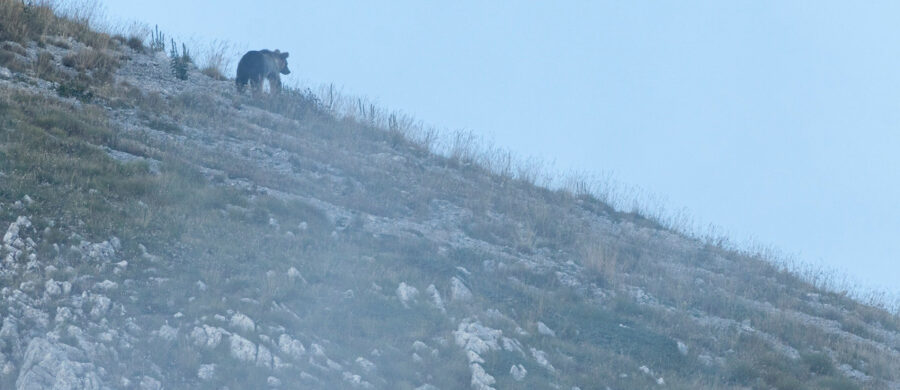
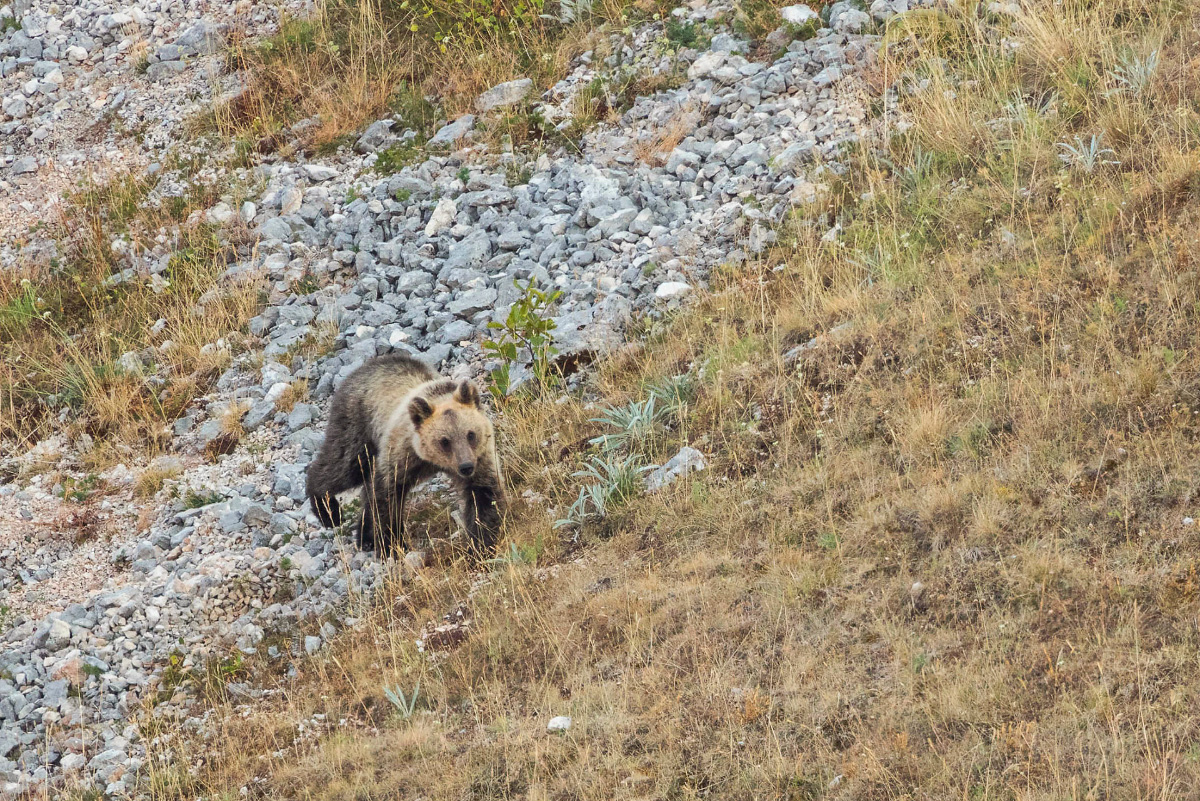
Il Parco Nazionale d’Abruzzo, Lazio e Molise e le zone limitrofe da sempre rappresentano la roccaforte degli orsi dell’Appennino.

Mi sit amet mauris commodo quis imperdiet massa. Vel pretium lectus quam id leo in vitae. Interdum posuere lorem ipsum dolor sit. Sed enim ut sem viverra. Mattis enim ut tellus elementum sagittis vitae et. Mattis enim ut tellus elementum sagittis vitae et leo. Et tortor consequat id porta nibh venenatis cras sed felis. Tincidunt arcu non sodales neque sodales. Fames ac turpis egestas maecenas pharetra convallis posuere morbi leo. Libero justo laoreet sit amet cursus sit amet dictum sit. Nunc mi ipsum faucibus vitae aliquet nec.

Consectetur purus ut faucibus pulvinar elementum integer enim. Blandit aliquam etiam erat velit scelerisque in. Purus in mollis nunc sed id. Tincidunt arcu non sodales neque sodales ut etiam sit. Tellus integer feugiat scelerisque varius morbi enim nunc faucibus. Suspendisse faucibus interdum posuere lorem ipsum. Tincidunt eget nullam non nisi est sit. Phasellus faucibus scelerisque eleifend donec.

Alcune delle specie più note e preziose della biodiversità del PNALM: Picchio dalmatino (Picoides leucotos lilfordi); Camoscio appenninico (Rupicapra pyrenaica ornata); Lupo (Canis lupus); Cerambice del faggio (Rosalia alpina); Scarpetta di Venere (Cypripedium calceolus); Faggio (Fagus sylvatica);  Vipera dell’Orsini (Vipera ursinii); Gaggiolo marsicano (Iris marsica); Coturnice (Alectoris graeca); Salamandra pezzata (Salamandra salamandra gigliolii).

A BEAR-FRIENDLY COMMUNITY
A LOVE-HATE RELATIONSHIP

It is not uncommon for a Marsican bear to pass through a built-up area, while moving from a place to another of its territory. However, if some bears are rewarded repeatedly with foods, they will want to return again and again to obtain them when and however they want. If conditioning is also associated with a loss of mistrust of humans, some bears may start to become bulky neighbours.

Giving up some habits and behaviours, we can build a real community and ensure a peaceful life for as and bears.

link al progetto

Le valli, le foreste gli ambienti rocciosi sono popolati da una grande varietà di vertebrati e invertebrati, con numerose specie endemiche o molto rare altrove. Il Parco protegge gran parte delle specie tipiche degli ecosistemi montani e, in particolare, dell’Appennino. Tra i mammiferi, spicca la comunità di ungulati selvatici, con cervi (Cervus elaphus), caprioli (Capreolus capreolus), cinghiali (Sus scrofa) ed esclusivi camosci appenninici (Rupicapra pyrenaica ornata): potenziali prede non solo per l’orso, ma anche per il lupo, qui presente con una popolazione ad alta densità. Ma non ci sono solo erbivori selvatici. Dai primi mesi estivi fino all’inizio dell’autunno, gli animali domestici (pecore, capre, mucche e cavalli) vengono ancora portati al pascolo tra queste montagne, spesso ad alte densità e, nel caso di bovini ed equini, allo stato semibrado. In tutta l’area è documentata la presenza di cani da guardiania associati al bestiame, ma anche di cani vaganti e inselvatichiti.

La roccaforte degli orsi

Entra nel cuore dell’Appennino, percorrendo le valli segnate dagli uomini fino alle cime più alte, da cui lo sguardo spazia sulle grandi foreste e verso nuovi territori.

A partire dal Neolitico, il paesaggio dell’Appennino si è sviluppato di pari passo con le attività umane, in particolare la pastorizia, vera forza plasmatrice del territorio. Le tracce di tutto ciò sono ancora evidenti nei coltivi abbandonati e nei resti di vecchi stazzi, rinvenibili anche in aree remote, nonché nella rete di sentieri e strade che sono presenti quasi ovunque. Oggi, nel Parco, la densità abitativa è di circa 15 persone/km2, mentre la densità di strade asfaltate al suo interno è pari a circa 39 km/100 km2. L’allevamento del bestiame, le attività di taglio forestale e il turismo sono importanti risorse economiche, mentre l’agricoltura ormai è limitata principalmente alle zone di fondovalle, nei pressi dei centri abitati. Lo sfruttamento dei boschi è svolto con l’autorizzazione del Parco, tranne in alcune aree particolarmente delicate prese in affitto dall’Ente stesso per prevenire il deterioramento dell’habitat. L’attività venatoria (cinghiale, lepre e avifauna) è consentita esclusivamente nell’Area contigua del Parco, tra i mesi di ottobre e gennaio.
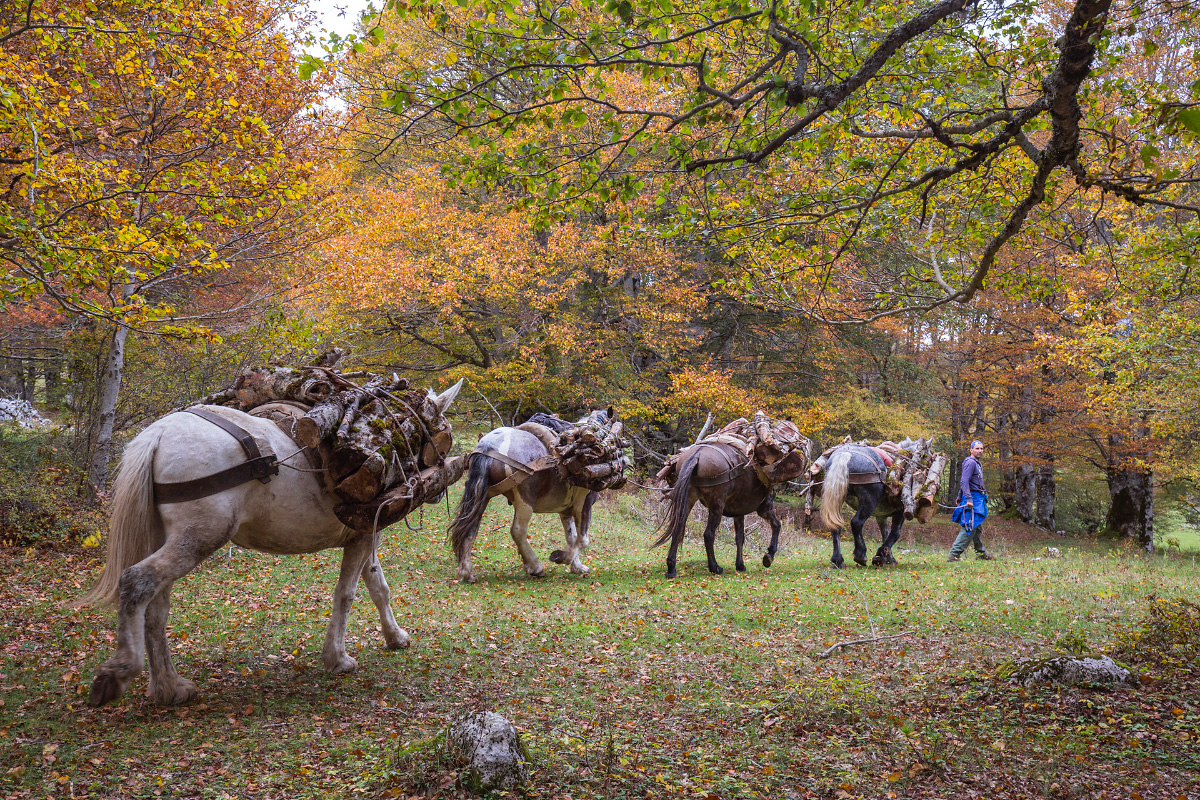
Nell’ambito del PNALM sono praticate molte attività tradizionali di sfruttamento del territorio, come quelle di taglio boschivo, con l’esbosco ancora svolto con muli e cavalli.

Per la complessità storica, culturale ed ecologica del territorio in questione, le relazioni che legano l’orso, l’Appennino e l’uomo possono essere davvero innumerevoli e sorprendenti. Più che in molte altre regioni del Pianeta, la vita degli orsi di queste queste montagne da migliaia di anni è intrecciata a ciò che li circonda, da un filo d’erba o una formica fino ad arrivare all’uomo e alle sue attività. La relazione con la nostra specie, in particolare, viaggia da sempre su due polarità, di attrazione o repulsione, variando costantemente nel tempo a seconda delle culture prevalenti.
Beyond the bear

Beyond the bear

Bears build relationships with everything around them

READING TIME12 MIN

Every living organism is part of a whole. A plant, an animal and a rock are all interdependent.

The relationships may be innumerable, according to many experts, many more than we could ever imagine. Organisms compete with each other if they have too many things in common (e.g. food). Some kill to survive, the so-called predators; many organisms form intimate associations, genuine alliances or “symbioses” often benefiting both. Relationship after relationship, the lives of prey, predators, their associates and their environment intertwine in a unique and ever-changing dynamism eternally striving for balance. And that is how an ecosystem is born. You just need to pull one thread of this dense weave tighter to change the direction and intensity of the relationships, creating a sudden and unpredictable domino effect. If one of these threads breaks due to unnatural causes, the weave may unravel beyond hope of recovery. Every day, the lives of bears intertwine with those of other living (wolves, deer, squirrels, ants and plants) and non-living (rivers and soil) organisms, writing tales of nature that inspire wonder and a sense of belonging.

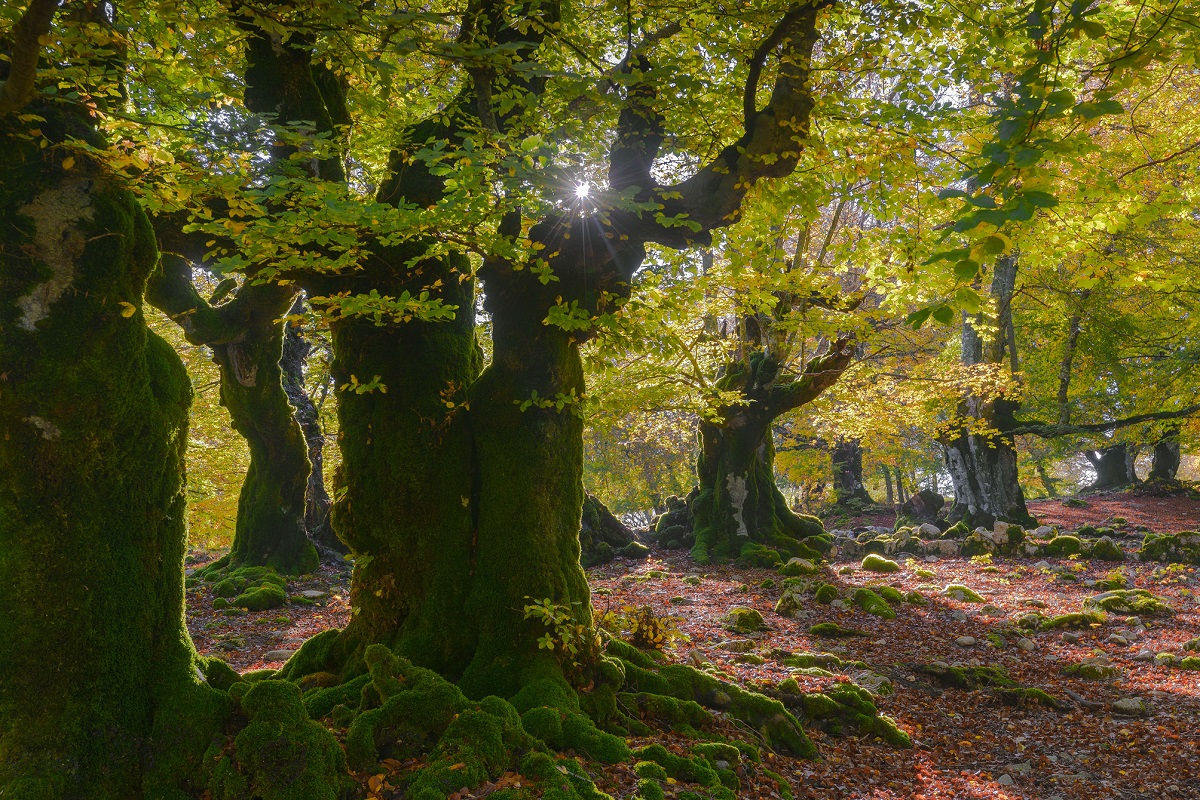
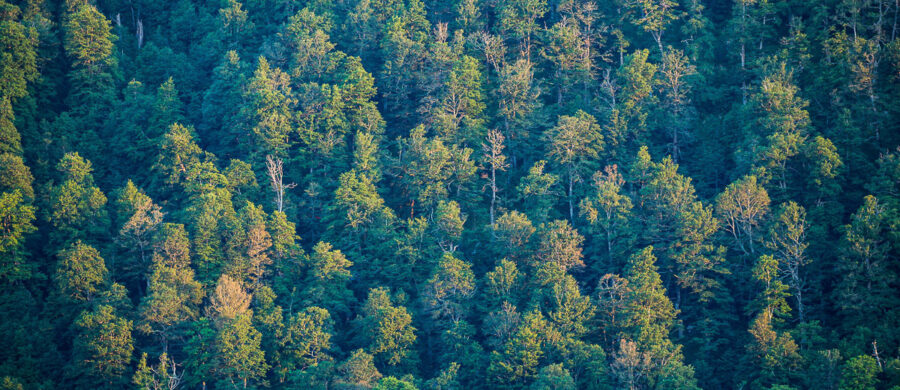
Dall’orso al picchio dalmatino, dalla volpe alla cincia mora, dalla rosalia alpina al ghiro: la faggeta è l’habitat prediletto da molte specie e l’orso appenninico è al centro di una fitta rete di connessioni che lega tantissimi organismi diversi.

A bear’s paw on an ant nest can work better than an insecticide

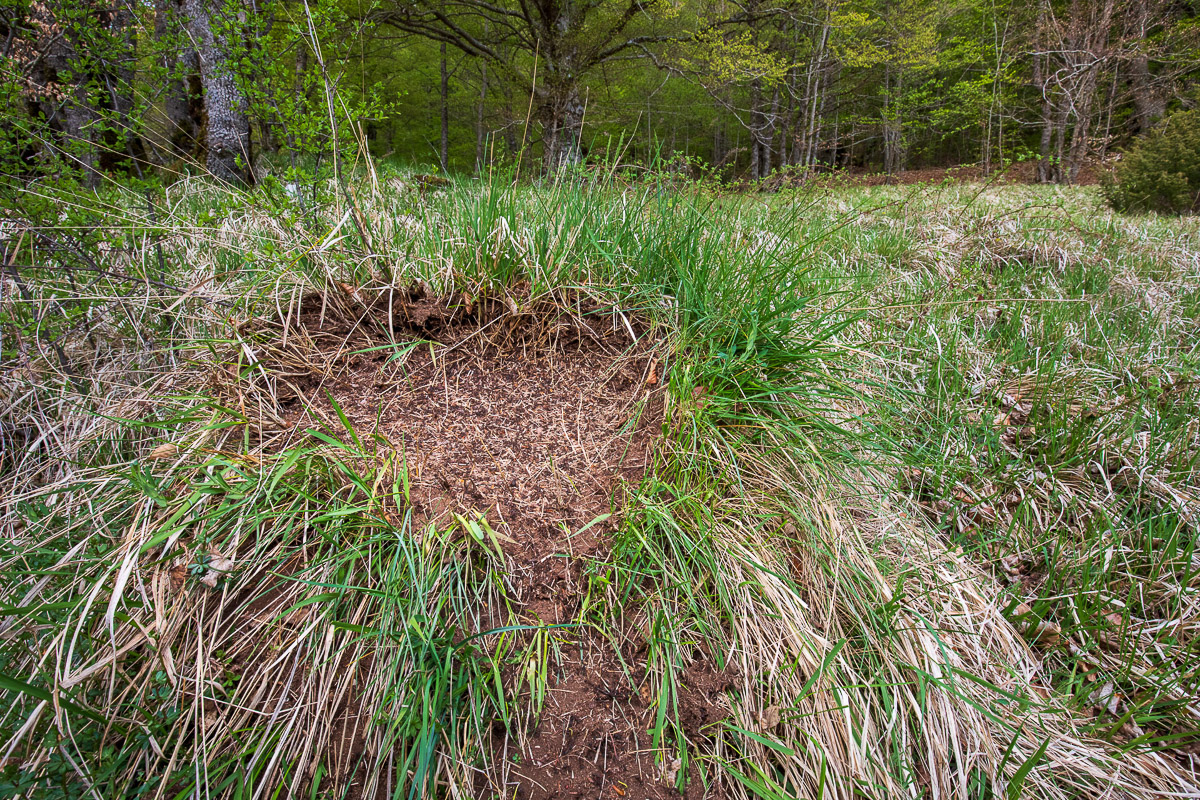
I resti di un grande nido di Formica pratensis in primavera completamente distrutto da un orso appenninico in cerca di larve.

Ants are among the most cooperative organisms in the world, and not just among themselves. For example, they offer protection to bizarrely shaped insects belonging to the Membracidae family, which they “farm” in exchange for the molasses they defecate after feeding on plant sap. Similarly, by also hunting arthropods such as spiders, ants create a danger-free environment for many herbivorous insects (aphids, cicadas and beetles), which can then “graze” in peace. But in the land of bears, ants do not have an easy time of it. Bears are very fond of both adults and larvae and destroy their nests with their paws in order to eat them. Researchers in the USA have found that bushes of a plant in the Chrysothamnus genus (the same family as sunflowers) are much more luxuriant near damaged nests. How is that possible? Well, thanks to the bears, while the remaining ants are busy rebuilding their nests, many small predators such as spiders are gaining ground again and killing many species of herbivorous insects, allowing the plants to germinate and grow better.

Bears plant seeds like zealous farmers providing food for themselves and many other animals.

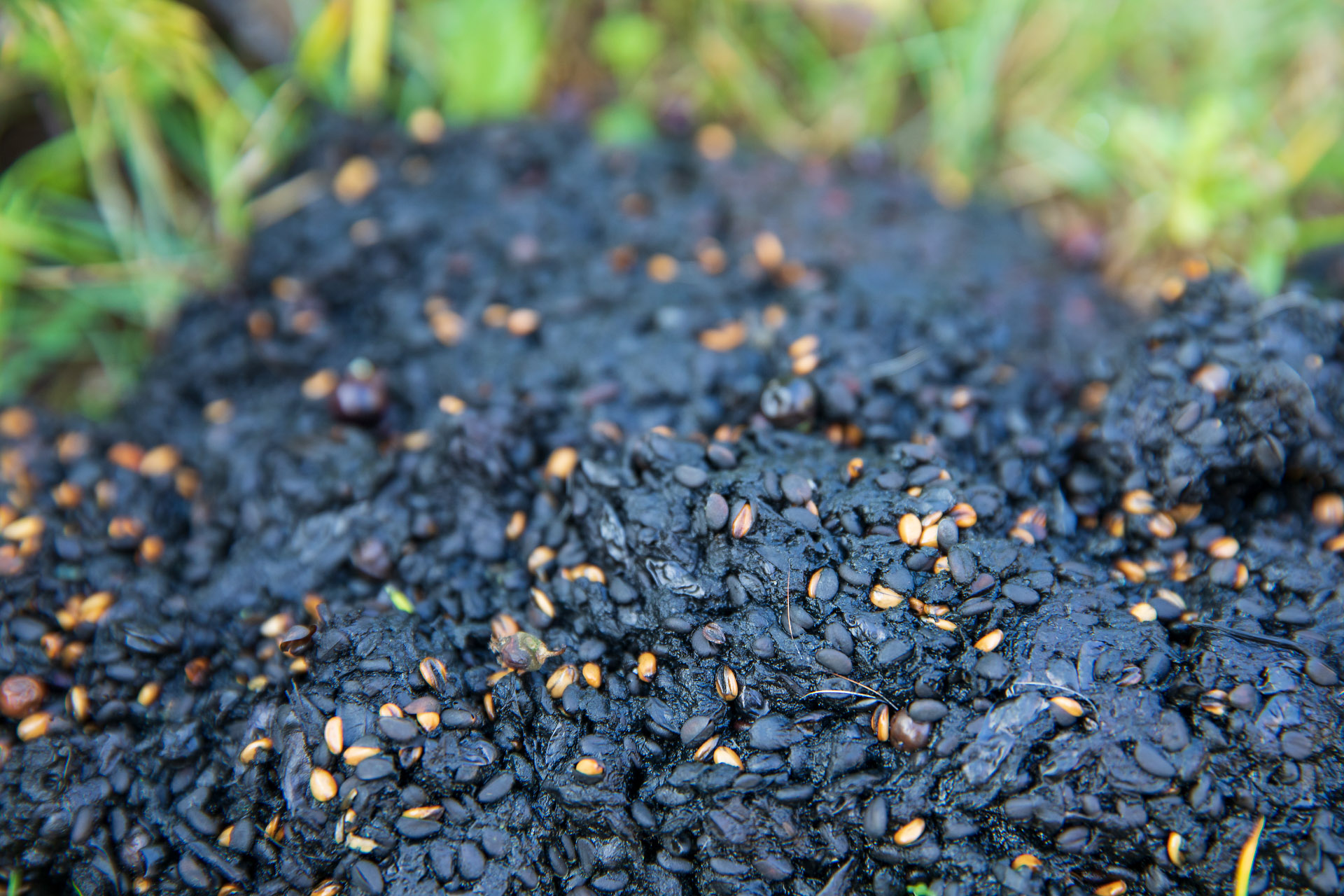
Un orso si muove tra i cespugli di ramno, carichi di bacche alla fine dell’estate. In questo periodo, depositando in giro gli escrementi pieni di semi, il plantigrado può contribuire alla diffusione di questa pianta.

According to studies conducted along salmon rivers and streams in Alaska, brown and black bears can sow over 200,000 seeds of different berries in a single square kilometre. What’s more, a single bear may consume over 100,000 fruits in just one hour. But is it only bears that benefit? Experts say that’s not the case. Bears, first, followed by birds and small rodents, all contribute to disseminating the seeds of the fruits, facilitating the occupation of new territories and the search for more favourable environmental conditions, reducing competition between seedlings and the risk of cross-fertilisation. Bears are very effective at this, as they occupy territories as large as hundreds of square kilometres, cover distances of tens of kilometres while they are digesting and spread at least seven droppings a day. Research in Sweden has shown that seeds in bear droppings, stripped of their tegument during digestion, germinate one month earlier than those contained in fruit that just fell onto the ground. In addition, since bears defecate where they rest, the soil disturbance associated with the creation of a bed could help create the best conditions for seed germination. As bears also climb mountains every day, research has shown that transporting seeds to higher altitudes can help many fruit species, such as cherries, to combat climate change by migrating (or rather being transported) to cooler areas.

Salmon attract dozens of bears, thus making life easier for mice and voles

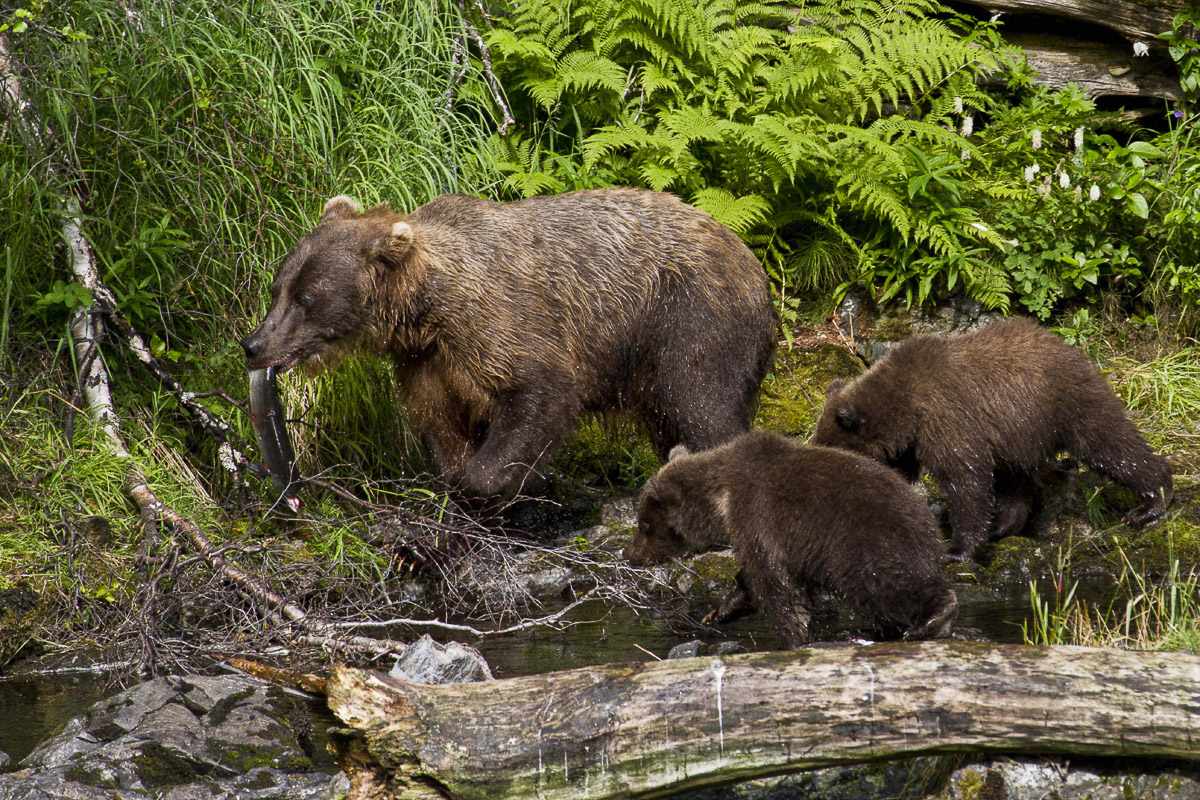
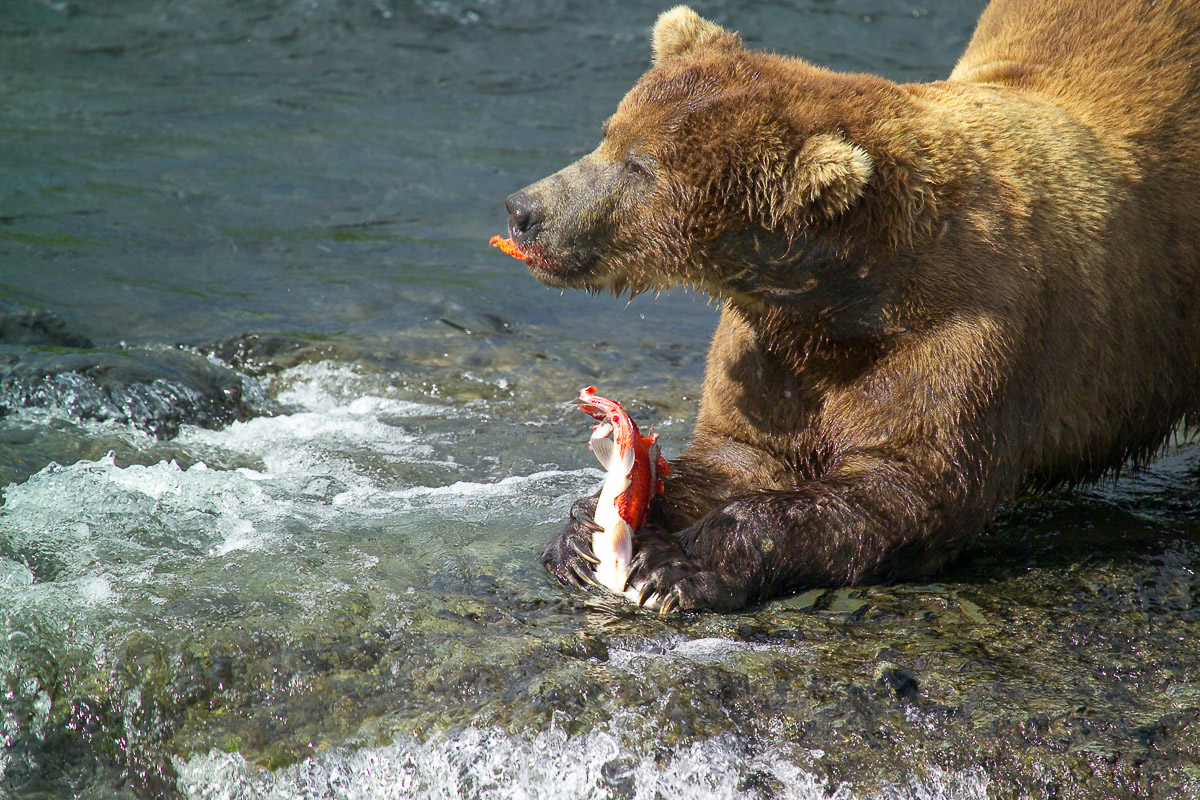
From May to September, Alaska’s streams and rivers come decidedly to life. Thousands of salmon swim up the rivers from the ocean coast to breed and lay their eggs. Bears are not indifferent to this incredible spectacle. From June onwards, dozens of bears congregate along the banks of the rivers to take advantage of all this fat and protein. In order to become obese as quickly as possible, bears also eat a lot of blueberries and berries of the Oplopanax genus, also known as devil’s club fruit. Using camera traps, researchers have discovered that mice and voles scavenge bear droppings. It’s not surprising… a single bear dropping may contain over 70,000 devil’s club seeds. In practice, a single excrement can meet the calorie needs of at least 90 mice. Considering the large number of bears that frequent the edges of streams and rivers during the summer, researchers have found that more than 50% of the rodents present only survive thanks to the bear droppings

Alle maggiori latitudini, la risalita stagionale dei salmoni determina una fondamentale disponibilità di cibo per orsi e tante altre specie. Trasportando i resti dei pesci dai fiumi sino all’interno delle foreste, gli orsi contribuiscono a disperdere le sostanze nutritive che arrivano dal mare.

Bears and salmon team up to improve water and soil quality near rivers and streams

Stable isotope analysis of carbon and nitrogen has been used to study the flow of organic matter between the ocean and rivers in the boreal forests of North America. Nearly 26% of the nitrogen contained in the plants living along the river banks was found to be of marine origin. But how does nitrogen make its way up rivers against the current? In summer, bears in particular eat about 40% of the available salmon that swim up the rivers to spawn, distributing the marine nitrogen up to more than 500 metres from the river banks by leaving the remains of carcasses, defecating and urinating. For example, research has shown that more than 80% of the nitrogen of marine origin measured in silver fir leaves is transported by the bears themselves. Well-nourished riparian trees grow faster and denser, making them more attractive to deer and elk. They stabilise banks more efficiently, filter sediment, thus making the waters clearer, and create better shelter for growing fry. By providing food and nutrients, the bear and salmon team drive a genuine community that includes all links in the food web: scavengers, decomposers, herbivores and predators. Scientists say that the loss of either species would have serious environmental consequences for all organisms living in the same environment, from an alga or a bacterium to dozens of species of mammals and birds.

The wolf makes life easier for bears, even changing their habits

In 1995, wolves were reintroduced to Yellowstone National Park in America after an absence of more than sixty years. A research opportunity that experts were sure to exploit. What did the arrival of the wolves entail? Firstly, the wolves reduced the number of their favourite prey, the wapiti deer, and also influenced their feeding habits which changed as they needed to escape their new predators. In turn, there was an explosion in the growth of many berry-producing shrubs as there was less feeding pressure from the deer, increasing the availability of the berries and their consumption by grizzly bears. Not only shrubs, but also the riparian vegetation along many rivers became more lush, providing an ideal environment for many bird species and beavers, which increased in numbers. By building their dams on the rivers, the beavers created new ecological niches that favoured otters, fish, reptiles and amphibians. What’s more, with the return of the wolf, the availability of deer and elk carcasses also increased throughout the year, providing new food resources for crows, magpies, eagles, bears and coyotes, especially in the winter season. This is what is known as a trophic cascade. An ecosystem has changed and been enriched by the return of one of its links that had previously been eliminated at the hand of man.

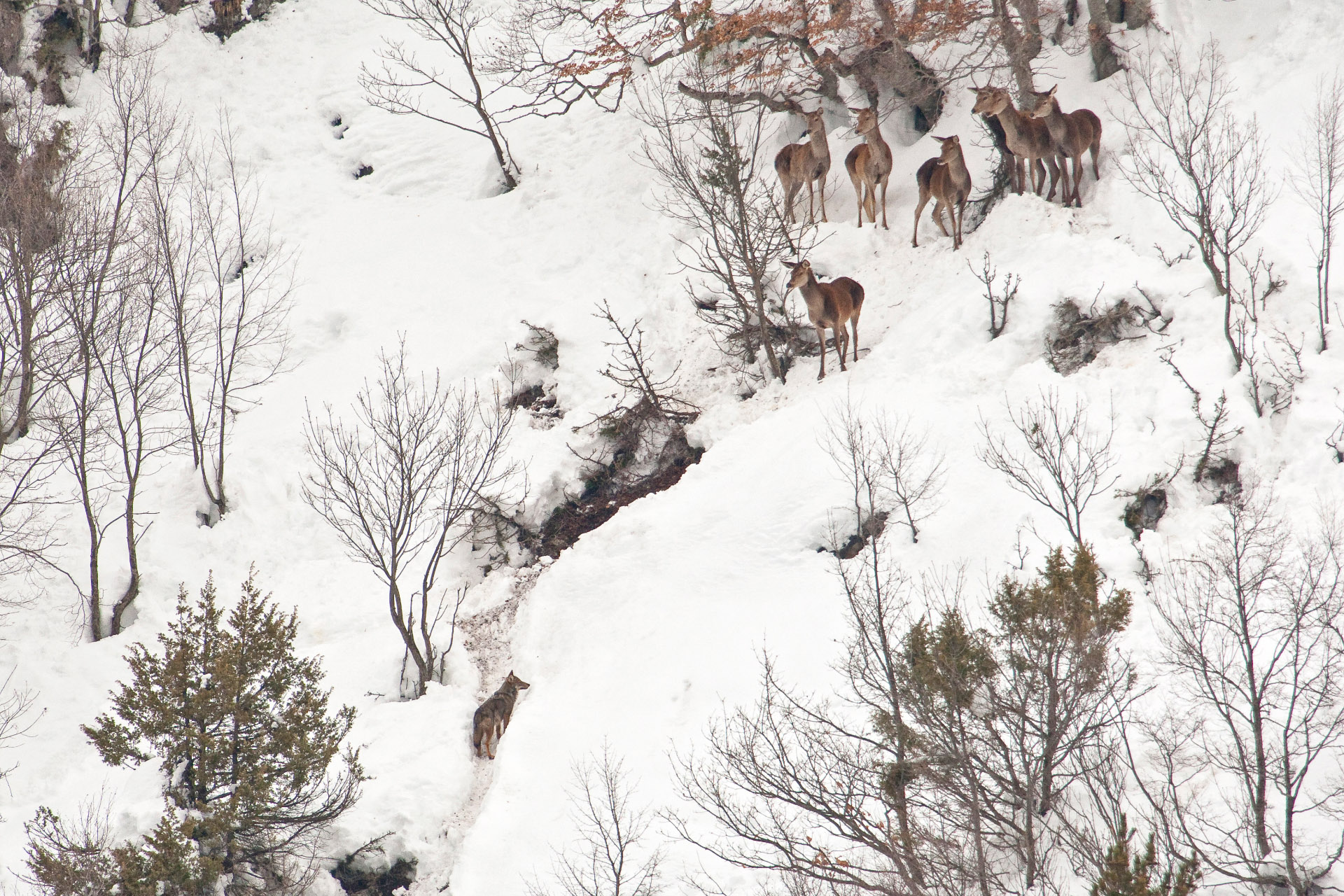
Il confronto fra un lupo e un gruppo di cervi bloccati dalla neve nel cuore dell’inverno su un pendio dell’Appennino. Con la loro presenza, i grandi carnivori influenzano il comportamento e i movimenti degli ungulati selvatici.

Opportunity makes the bear thief, anything goes to become obese

Bears are very good at snatching prey from wolves and lynx, a behaviour known as kleptoparasitism. But researchers have found two more victims of the bears’ acts of piracy. These are two small rodents, each weighing no more than a few hundred grams. Between April and May in Yellowstone National Park, bears spend a lot of time digging their muzzles into the still partially snow-covered grasslands. This environment is home to a small rodent with subterranean habits, Thomomys talpoides, which feeds on plants and roots. These animals hide their food in elaborate tunnels, the entrances to which are visible on the ground in the form of mounds of earth. Although they also occasionally feed on a few individuals, bears plunder the reserves accumulated by these rodents, rich in roots of yampah and Claytonia virginica. But it is in autumn that the bear meets its second victim. In years when there is an abundance of pine nuts (Pinus albicaulis), rather than obtaining these seeds directly, more than 90% of the time the bears steal them from the underground stocks of red squirrels. In practice, the bears depend on a squirrel to exploit an energy-rich resource, essential for spending the winter fasting and breeding successfully.

Bears are environmental engineers, turning bark into food and shelter

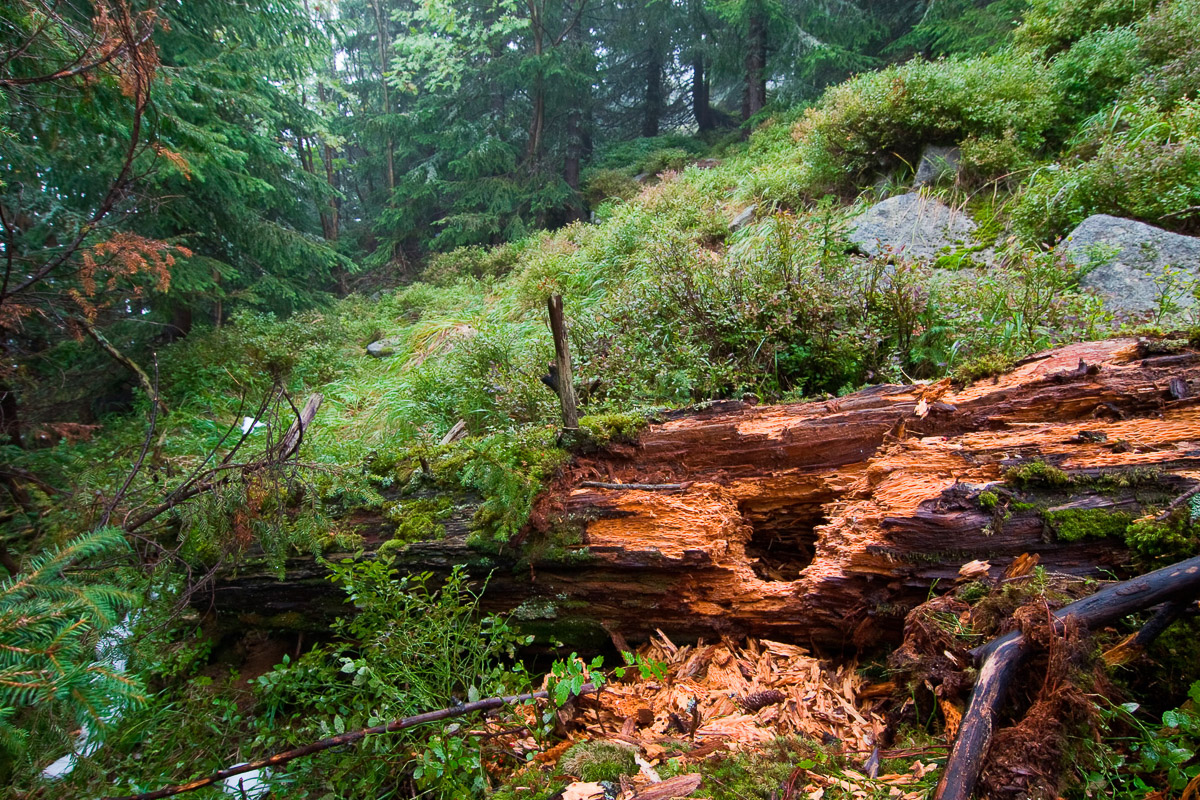
I segni lasciati sul tronco morto di un abete dai morsi e zampate di un orso bruno in cerca di larve di coleotteri e altri invertebrati.

Bears mark their presence on tree trunks with scratches, bites and their own scent by rubbing the trunks intensely. These marking trees may be used by animals year after year, even over a very long period of time. But bears also bite into the tree bark to feed on the sap, eat ants in the wood and even dig out their own dens. By analysing 278 marks left by bears on the bark of silver fir trees, a study carried out in the northern Carpathian mountains in Poland showed that in more than 40% of cases, wood-eating insects had dug tunnels in the bark and in most cases it had also been drilled by woodpeckers. The most affected “wounds” were the oldest, dating from at least five years earlier. How to explain this phenomenon? As the “wounds” are exposed to the weather, micro-organisms and fungi, they decompose and become an ideal micro-environment for many species of beetles (some very rare). These lay their eggs in tiny holes in the bark and their larvae then feed on the wood, excavating tunnels. But these same larvae are also gathered by woodpeckers, which take advantage of the areas already barked by the bears. In addition, the study showed that “wounded” trees were also colonised by other animals (such as rodents and amphibians) which found a comfortable shelter and protection there.

In the Apennines, many of the relationships between bears and their environment have yet to be discovered, but based on the many studies carried out worldwide, there is no doubt that bears can also play a key role in the balance of these environments

The bears’ Apennines

The bears’ Apennines

The interweaving of human and natural history going back
thousands of years has created a varied environmental mosaic and precious wilderness refuges

READING TIME 10 MIN

In order to live, brown bears need to move freely across vast spaces, find undisturbed areas to rest and have access to a wide variety of food resources depending on the season.

The Central Apennines is one of the few remaining areas in Italy still able to offer bears everything they need. The region’s rugged limestone mountains furrowed by long, deep valleys and above all the vast areas of woodland, mainly beech forests, have allowed bears to escape extinction and survive to the present day. The naturalness and richness of the environments safeguarded within the borders of the protected areas in the Apennines (such as the Abruzzo, Lazio and Molise National Park) are now famous and synonymous with unspoilt, wild nature, including at international level. But don’t be fooled by the apparent wildness of these places. With the exception of a very few areas, the wilderness is, so to speak, largely “secondary”, in other words, the high degree of naturalness was only reinstated during the last 50-60 years. The conservation measures introduced certainly contributed, but it was mainly a consequence of profound socio-economic changes in the region and abandonment of the traditional exploitation practised in these mountains for centuries.

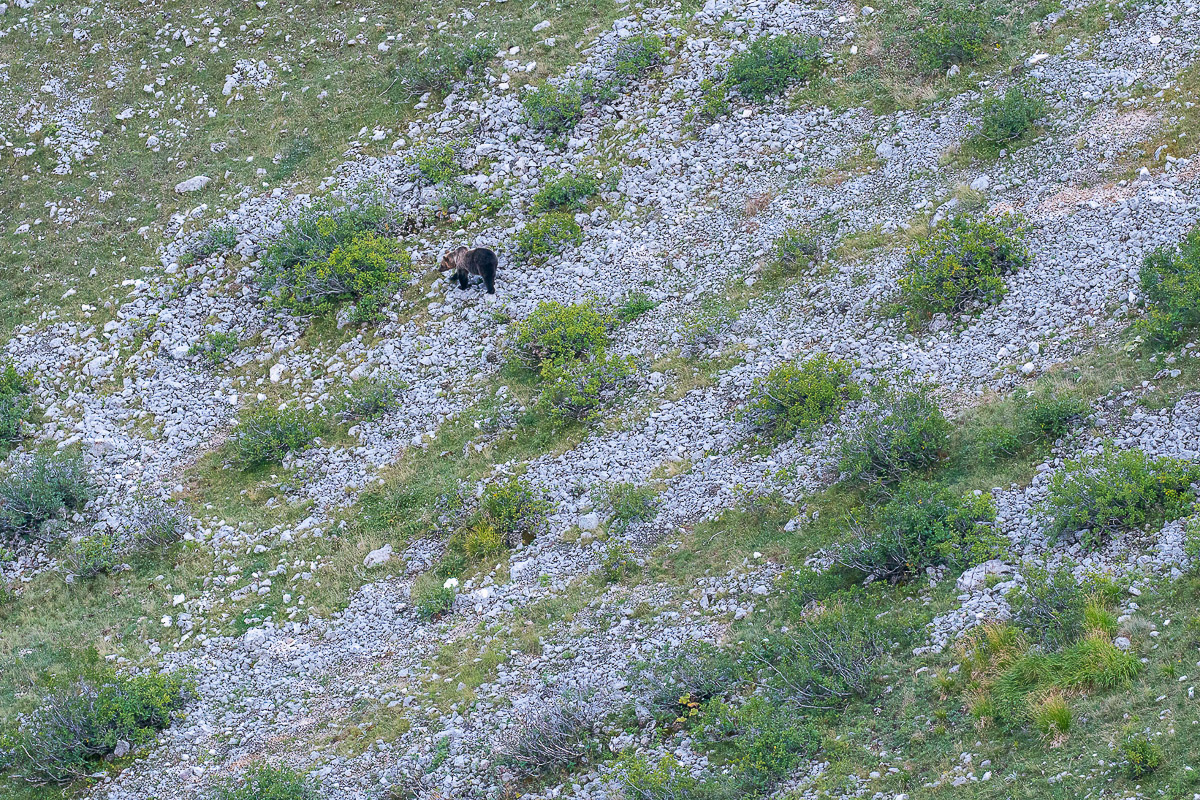
On a spring afternoon an Apennine brown bear wanders around an old ruined farmhouse. A large part of its range is now represented by secondary natural habitats originated from the abandonment of traditional land use activities.

The first traces of human habitation in the Central Apennines date back 500,000 years, well before the presence of Homo sapiens in Italy, datable to around 40,000 years ago.

But it was not until 7-8,000 years ago during the Neolithic that the first substantial changes in the environment began, largely coinciding with the advent of sheep farming and agriculture. After tens of thousands of years spent practising almost exclusively mainly itinerant hunting, fishing and gathering the wild products of the earth, for the first time, our ancestors entered in some ways into “competition” with wild nature and its bulkiest inhabitants. In order to create pastures for their flocks and fields to cultivate, Neolithic people used fire and the axe to clear ever greater space in the dense primeval vegetation. The ridges and slopes of the mountains and valley floors were thus almost permanently deforested, creating the vast, barren secondary grasslands so typical of the Apennine landscape. At the same time, central Italy saw the arrival of new domesticated animals and the first varieties of cultivable plants. In order to defend these, man had to deal with the large predators and herbivores present in the region. The advent of a more sedentary lifestyle and emergence of the first settlements brought new roads and infrastructure, later extended, improved and organised first during the Italic period, then in particular under the Romans. During this period of history, the human population grew considerably and the first important urban centres were established, including in the innermost areas. In the first centuries A.D., the Central Apennines from the hinterland to the coast were crossed by a complex road network and parcelled out and rigorously organised by the emissaries of the Roman government. All this, of course, at the expense of wooded and wild areas, in other words, the areas most suitable for the survival of large animals.

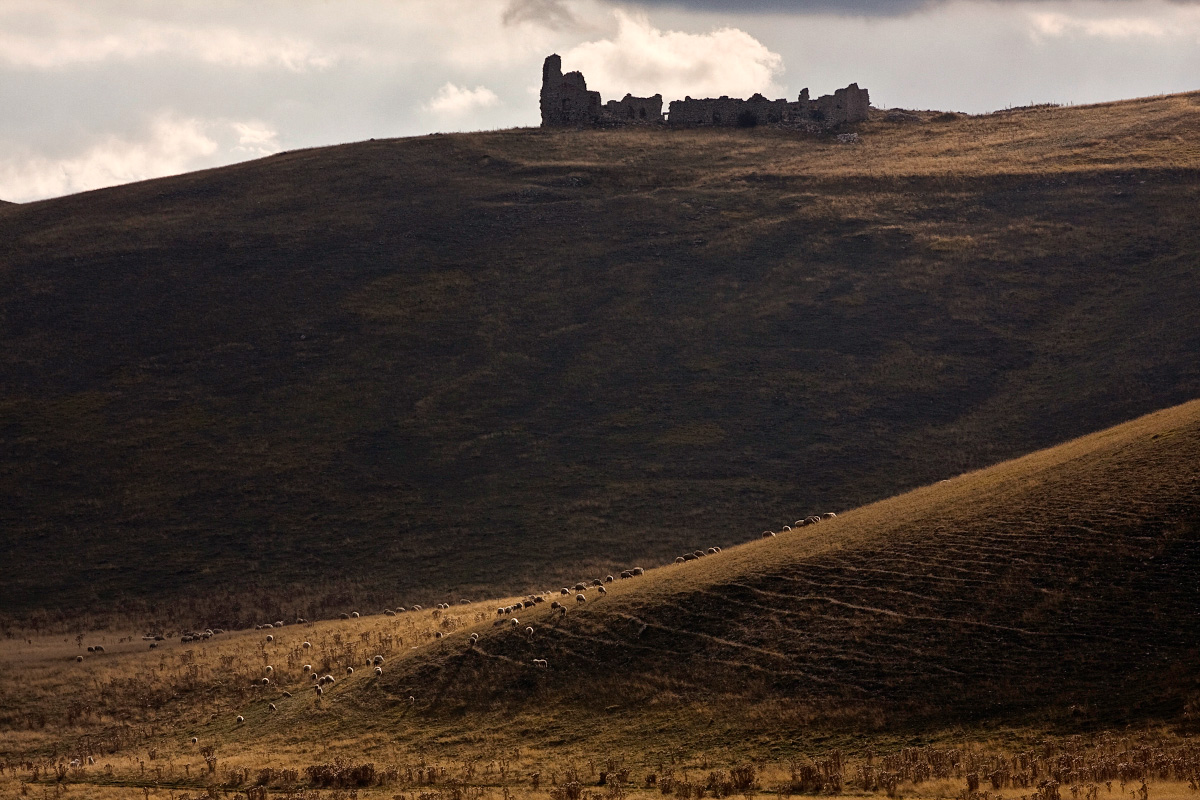
A flock of sheep grazes in the shade of the remains of the Grancia di Santa Maria del Monte in the Gran Sasso Massif. Founded by Cistercian monks in the 13th century, this high-altitude monastery remained in use until the end of the 16th century, when decreasing winter temperatures due to the Little Ice Age forced the monks to abandon it.

This particularly prosperous era for our ancestors was, however, destined to be short-lived. The Middle Ages, in fact, brought what was in some ways a step backwards. After the collapse of the Roman Empire and with the arrival in the peninsula of peoples of central European origin, bringing with them a culture and economy more focused on utilisation of the forest, many cultivated areas were abandoned and the woods and forests made a potent comeback throughout the Apennines. While wars, epidemics and famine decimated the population, in an increasingly less populated land, the colonisers went back to extensive hunting and semi-wild animal husbandry, bringing with them particular forestry methods.

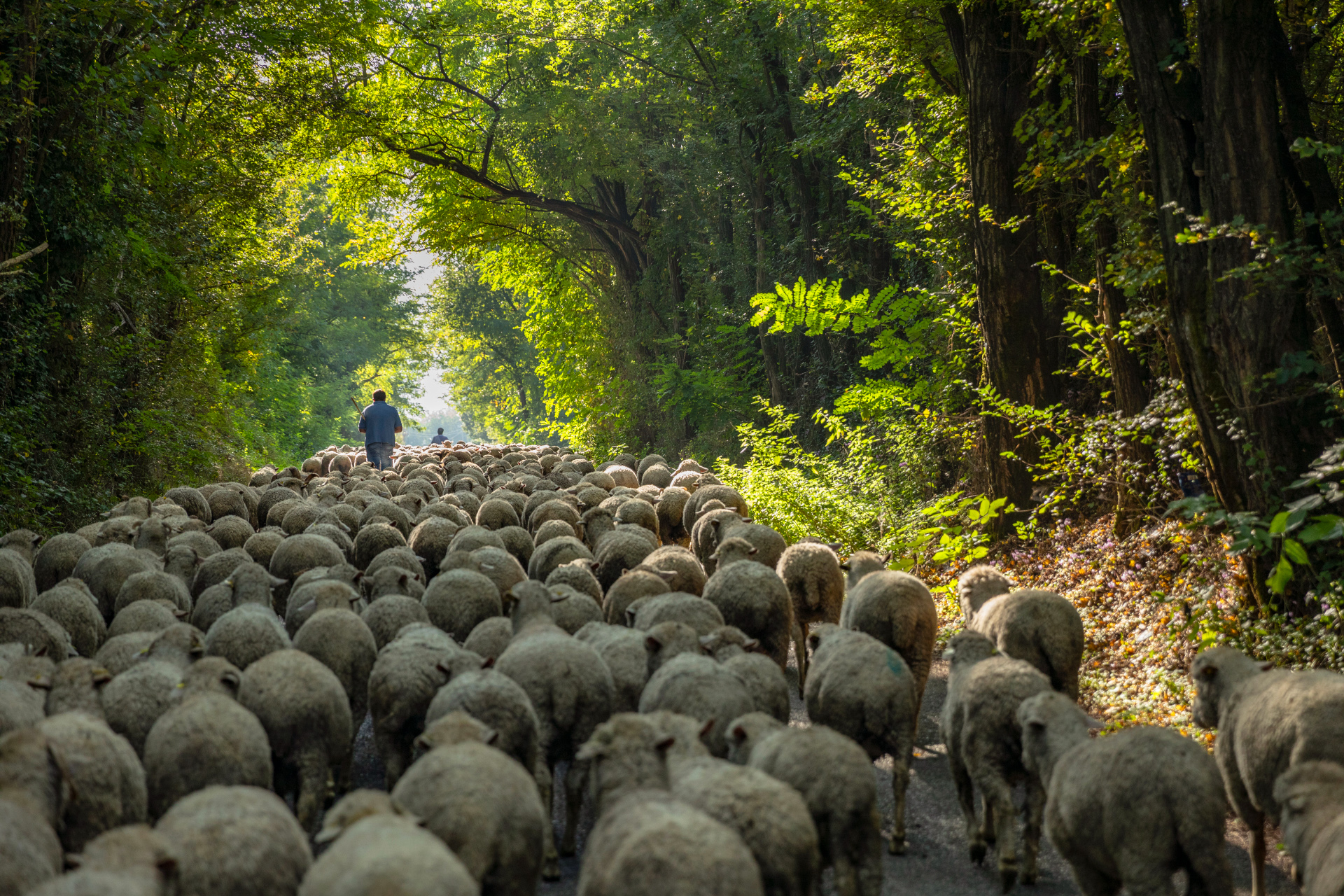
A Molise shepherd leads his flock during the autumn transhumance along one of the last remaining sheep tracks. Today, very little remains of a practice that once saw millions of sheep driven each year to winter in the Tavoliere delle Puglie.

Particularly significant among these was the “difesa” system of management, a method that has left numerous examples in the region (such as the beautiful Difesa di Pescasseroli and Difesa di Opi in the upper Sangro valley, or the Bosco di Sant’Antonio in the Maiella area). Usually located near a village, a “difesa” was a characteristic tree-dotted pasture for communal use, where cattle were left to graze among ancient trees, beech, oak and fruit trees in particular. These sizeable trees were pruned and pollarded repeatedly to produce more branches and thus more foliage and fruits to feed the domestic animals, particularly at the end of summer. Although of artificial origin, “difesa” beech forests today represent structurally very varied environments and important habitats for numerous species, from those seeking refuge in the hollow of old trunks to those only able to live under a partially open forest canopy. They are therefore essential to the conservation of Apennine biodiversity, including of course bears, which frequent them at many times of the year, especially in years of abundant beechnut production.

In this interview, Aurelio Manzi, ethnobotanist and scholar of the Central Apennines, illustrates the most salient moments in the history of the landscape of this region and how this is linked to the vicissituded of the Apennine bears.

At the end of the Middle Ages, an increasingly marked decrease in temperature throughout the Northern Hemisphere initiated the so-called Little Ice Age. With a particularly harsh climate, this period lasted until the 19th century and had a great influence on the distribution of humans and their activities in the Apennines. The cold temperatures and very long winters led to a strong and widespread demand for suitable clothing and coverings in general. Wool thus became one of the most important products at the centre of the economy and the trigger for the great epic of transhumance. It was during these centuries that the sheep farming industry in the region was at its most prosperous, with hundreds of thousands of sheep being driven annually along the ancient drove trails from the green mountain pastures of the Apennines to the wintering areas along the coasts and plains of northern Puglia in particular. While on one hand, for some families (albeit just a few), the prosperous economy based on sheep farming allowed the culture and economy to flourish again after centuries of uncertainty and poverty, on the other, there was once more a heavy impact on the natural environment and the forests declined again, together with the species depending on them. This was the period of maximum conflict between farmers and large wild predators.

A Molise shepherd leads his flock during the autumn transhumance along one of the last remaining sheep tracks. Today, very little remains of a practice that once saw millions of sheep driven each year to winter in the Tavoliere delle Puglie.

As the temperatures began to rise again at the beginning of the 19th century, the abolition of feudalism in the Kingdom of Naples and relative establishment of private property with the seditious laws promulgated by Napoleon’s brother King Joseph Bonaparte triggered a new colonisation of the mountains and a further penetration of man, reaching even the wildest areas of the hinterland. During these decades, forests were again extensively cleared, large animals (previously the property of the aristocracy) were hunted and land was cultivated even at high altitudes. The poverty of a large part of the population in regions such as Abruzzo and Molise drove entire families to live in the mountains, using caves or simple huts as dwellings and “claiming” land from the mountains, in other words, cultivating small plots of land on the better exposed mountainsides, sometimes after removing stones and rocks and terracing the slopes. The huge piles of stones and tholos huts often found in the Apennine pastures date from this period, silent witnesses to the labours and hopes of those generations.

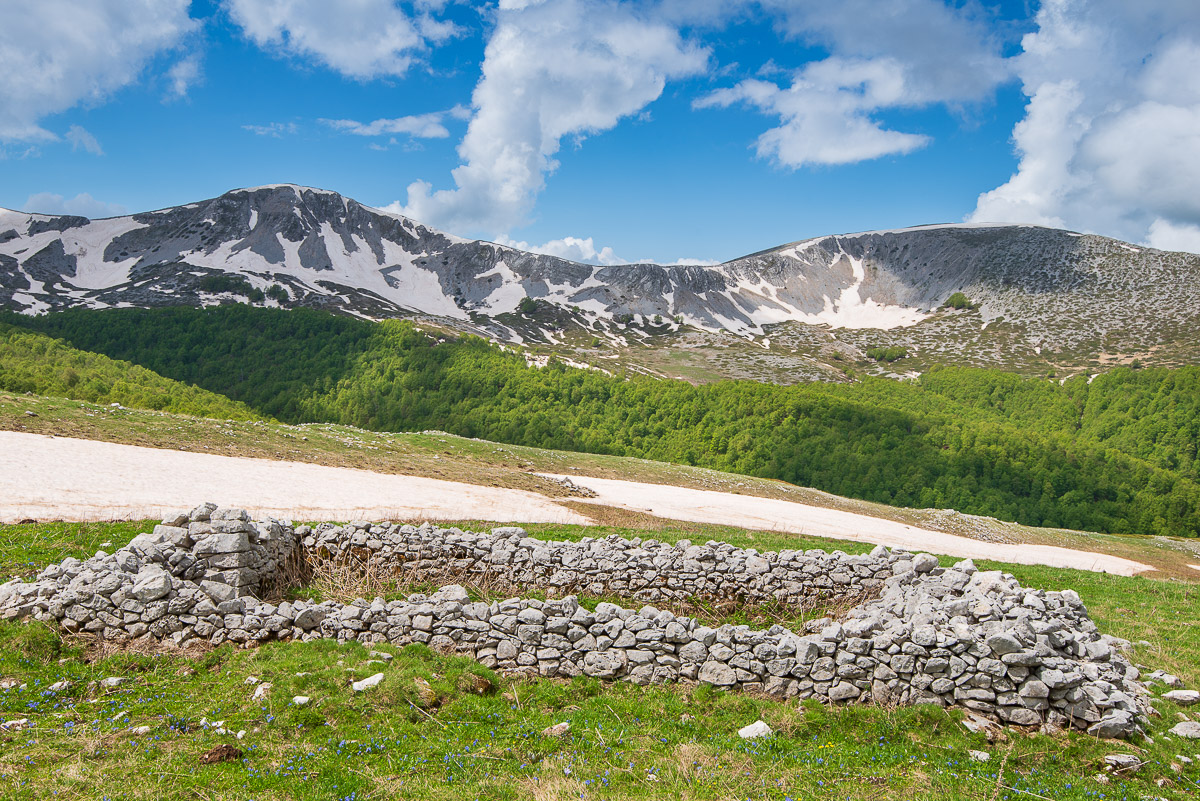
The remains of an abandoned “stazzo” (sheep corral) in the heart of the Abruzzi Apennines. Everywhere in the region there is evidence of the exploitation of the mountainous areas following the enactment of the laws on feudal eversion.

Exploitation of the territory and destruction of the natural environments and fauna of the Central Apennines continued inexorably until after the Second World War and the middle of the last century. With the exception of the fortunate and extraordinary case of the Monti della Marsica and upper Val di Sangro (transformed in 1922 from a hunting reserve to a protected area, the first nucleus of the Abruzzo National Park which would later expand to also reach the surrounding regions), most of the Apennines had to wait for the massive exodus from the countryside to the towns and cities and the end of the traditional rural economy before the woods returned to the slopes and were again colonised by large animals. The region’s exceptional naturalness and wealth of biodiversity today is due precisely to this process (known as “rewilding”), together with protection of certain species, especially carnivores, projects for the reintroduction of extinct species and, of course, establishment of the many protected areas in the Apennines (including the Gran Sasso – Monti della Laga and Maiella National Parks, the Sirente – Velino Regional Park and the regional reserves).

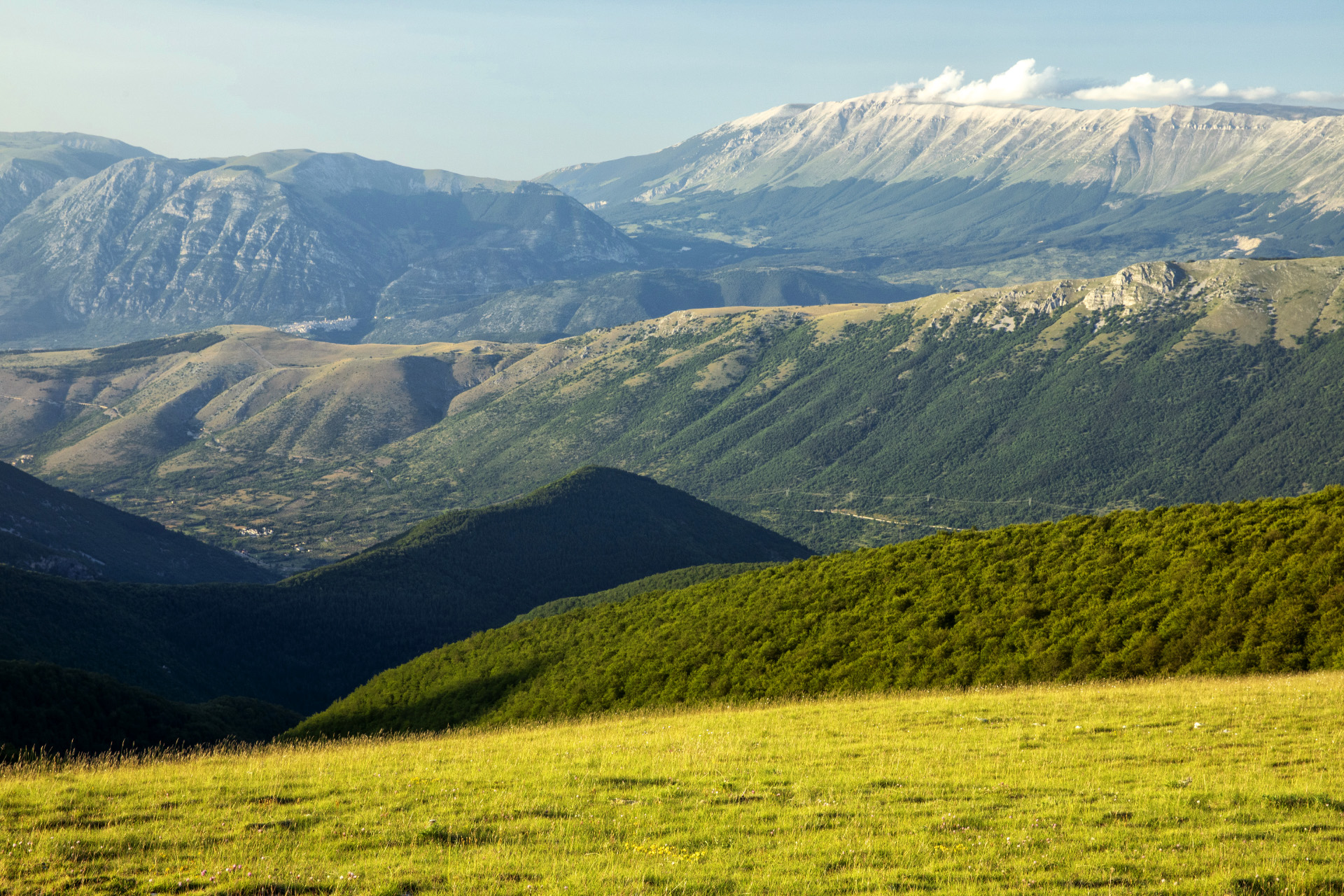
Green mountain ridges succeed from the Monte Genzana Regional Reserve to the heart of the Maiella National Park. The continuity of the protected areas of the Apennines and the efficiency of the so-called ecological corridors between the environments are the prerequisites for the expansion of the small Marsican bear population.

The complex and stratified historical vicissitudes of central Italy, combined with the territorial peculiarities of the Apennine hinterland, have laid the foundations for the creation of a rich and varied landscape. An environmental mosaic created by man and recently claimed back by nature, offering a great variety of environments and food resources to support the life of many species, a protective belt for the last, precious wildernesses of the high mountains, deep valleys and most intact forests.

It is up to us to preserve and manage it so as to avoid excessive environmental uniformity and ensure its productivity. Because it is precisely this mix of nature and culture that provides the exceptional setting for the wonderful story of Apennine bears.

A home for the bear

A home for the bear

The movements of bears reflect their needs and vary from season to season

READING TIME 15 MIN

In the Apennines, when bears decide to settle down for life, they opt for wooded areas sparsely inhabited or frequented by people, where they can move around without too many obstacles.

Once they’ve found their “home”, bears spend their daytime hours on wooded, rugged, inaccessible mountain slopes, if possible far from roads. But with the first shadows of twilight, they also venture down to the valley floor in search of food among the pastures, meadows, uncultivated land and farmland. Bears are creatures of the night and at first light, they return to their daytime refuges. In autumn, when the need to put on weight becomes a priority, the females in particular take advantage of a few extra hours of daylight to ensure they’re in the best possible condition to become mothers. The movements of these animals basically reflect what they eat and are never random. Bears always balance costs and benefits before setting out. Any trip away from their daytime refuges must serve to fill their stomach well or find a companion.

From quiet oak woods in late winter, to mountain meadows and shady beech forests in spring, to sparse glacial moraines in summer. A bear can visit a wide variety of habitats throughout the seasons in the central Apennines.

Bears are mostly vegetarian and the foods they feed on mature at different times of the year. No season is ever the same.

When they come out of their dens in the spring, bears mainly frequent the valley floor, the edges of streams and forests and snow-free areas where they are most likely to find succulent plants, carcasses of animals that have died during the winter, or newborn red and roe deer and wild boar. Each in its own way, the bears also scour semi-natural human-derived environments such as farmland, uncultivated land and roadsides, always on the lookout for the first tufts of grass. In the first four weeks after leaving the den, the bears move around and eat little, as their metabolic functions are still slow after the long winter break, but they gradually return to normal. Between May and June, the movements of solitary adult males and females in search of amorous adventures reach their peak. On the other hand, compared to other bears, mothers stay longer at high altitudes and near their winter refuges to protect their cubs, which are still too slow to keep up. As summer progresses, between June and July, the green of the new vegetation creeps progressively higher up the mountain slopes, attracting bears to the higher-altitude grasslands in search of not just herbaceous plants, but also the ants that teem in their nests under the stones. Unlike in other seasons, to seek out the ants, most active during the hottest hours of the day, bears also frequent areas rich in shrubs and bushes assiduously during daylight hours.

The beginning of August brings with it not only an abundance of fruits, but also the peak of tourism, bringing visitors to the Park. Something also changes in the bears. They begin eating a high-calorie diet to gain weight before the long winter. At the same time, the animals lead an ever more reserved life, withdrawing to inaccessible high altitude areas both by day and by night, avoiding busy roads and crowded populated centres as much as possible. In this season, mountain glades and scree are a constant destination for bears in search of alpine buckthorn berries. But in autumn, the bears return to the woodland, uncultivated land and farmland on the valley floor in search of berries and other fruits and nuts, especially apples, pears and acorns. In years with a bumper crop of beechnuts, they limit their movements to the beech forests.

BEARS AND CLIMATE CHANGE

Recent studies have shown that a bear’s home range (the territory normally frequented by the bear in a year or season) should contain at least 10% open space and the rest woodland in order to provide all the food necessary for its survival (acorns, beechnuts, berries, apples, pears, herbaceous plants and ants). Climate change models predict that over the next 40 years, average temperatures in Europe could rise by up to 2°C, with a parallel increase in heavy rainfall during the spring and severe droughts in summer. In this scenario, over the next few decades, bears will have to adapt to a great many changes: more forest cover, fewer open spaces and a transformation of beech forests to oak woods. The dietary flexibility of bears in the Apennines and the diversity of the foods they feed on certainly give these animals an ace up their sleeve to survive these changes. But the situation needs close monitoring, because every plant can react differently.

The homes where bears live must meet many requisites and satisfy all their needs for food, safety and reproduction.

In the Apennines, each individual bear is different and the size of home range can differ up to three times between males and females. The home ranges of Marsican bears can vary between 30 and 300 km2 and they are in every way comparable to those of brown bears living in areas even more productive than the Apennines.

WHAT IS A BEAR’S HOME CALLED?

Every living being has its own home range, in other words, an area where it habitually eats, breeds and looks after its offspring. An ideal home range is one where you can find a companion to mate with, sufficient food resources and areas safe from competitors and predators. For bears, the concept of home range is very dynamic and both its size and use may differ greatly, depending on annual and seasonal variations in the most palatable foods, health and reproductive status of the animals, presence of competitors and disturbance factors, such as, for example, human infrastructure. Some areas, usually coinciding with refuge and feeding areas, are used more often than others and are known as core areas.

The home range can be measured in many methods. The Minimum polygon complex draws a polygon around the extreme localizations of a bear’s range, while the kernel methods draw a boundary around the most intensively areas used by a bear. See the map.

Bears always use the same central areas from one season to the next, but their home range may shrink, expand or lengthen depending on their reproductive and nutritional needs and the distribution of the most palatable food. The most significant changes have been observed at the transition between summer and autumn, when it may halve or even double, depending on the bears or the years. In autumn, bears feed mainly on nuts and the abundance of these may vary greatly from year to year. For example, when there is a bumper crop of beechnuts, bears limit their movements to the beech forests, staying for weeks on end in even very small areas. Their territories will therefore be smaller than in years when the beech forests produce few beechnuts.

Males always have larger territories than females. In particular, during the breeding season between late spring and early summer, adult males double their movements to reach and mate with as many females as possible, in accordance with a polygamous reproductive strategy. Males expand their territories to include up to six different adult females. While females with young tend to restrict their movements in the early summer months to reduce the risk of infanticide by adult males, in the other seasons they expand the areas where they live to meet the nutritional needs of the whole family.

Bears are not exactly territorial and tolerate each other, although they know when and how to share out the space so as not to overlap excessively.

Bears tolerate each other and can share the same home, but season and personality play a role. The most tolerant are mainly the females which tend to remain in the same territory as their mother, while males are driven to disperse in their early years. For example, in the Park, a bear may encounter 4 other individuals in every 100 km2. The fact that bears in the Apennines are very indulgent towards each other is evident in both summer and autumn, when gatherings of up to nine bears can be observed together within a few square kilometres. However, overlapping does not necessarily mean frequenting the same areas on the same day or at the same time. Bears are, in fact, very adept at dividing up the calendar of presences in a specific area. On the other hand, if they cannot avoid a sometimes close encounter, they know how to interact to prevent tension and conflict.

The bears are “packed in tightly” in the Park, suggesting that this area will not be able to accommodate more bears than there are already.

Given the high extent to which the home ranges of bears in the Park overlap, it seems reasonable to assume that these animals are beginning to feel a little “cramped”. What can happen to the bears in a situation like this? Younger bears are generally driven away to marginal areas or to seek out new territories further afield, while for those that remain, control mechanisms may come into play, for example, to limit births. Older dominant females may exercise their authority to prevent younger females from reproducing, or the cubs may fall victim to more cases of infanticide by adult males. What evidence is there for the bears in the Park? The low reproductive rates in the females and more recent phenomenon of young bears frequenting built-up areas indicate that such a phenomenon is taking place. In recent years, there have been more and more reports of male and female bears outside their habitual distribution area. A good indication that bears are being driven to move away from the areas where they are usually present.

BEARS ELSEWHERE

In bears, dispersal (moving away from the maternal territory) is a purely male phenomenon. Typically, more than 90% of males move away in dispersal within the first 5 years of live, travelling even hundreds of kilometers. Playing on their home pitch, in other words, remaining in a territory where they know every blade of grass, is very advantageous for a female who must stay fit and healthy in order to reproduce. Females remain much more attached to their mother’s territories (a phenomenon known as philopatry) and rarely stray more than 70-80 km from where they were born. Bears looking for new territories, or arriving in areas with a low density of bears and therefore little competition, may occupy territories up to three times larger than they would have occupied in the area where they were born, especially if they are forced to move in highly fragmented areas.

Throughout history, man has always altered the natural habitats of the Apennines, and the Park represents a true mosaic of environments.

Despite the observed tendency of bears to prefer home ranges with natural environments, roads and built-up areas can occupy up to half the territory of some bears. So for a bear, frequenting areas inhabited by man is actually not so strange. Some bears regularly cross villages, although they do so at night. This behaviour can be exacerbated when young bears and females with cubs choose to live near these areas to escape the males. When this happens, also considering the presence of factors of attraction in populated places, such as fruit trees, some bears may lose their fear of humans and become accustomed to living in less wild areas.

Se ad un orso si offre la possibilità di accedere liberamente ad alberi da frutto non protetti, all’interno di un centro abitato, questo potrebbe scegliere di tornare ad una tale risorsa e perdere via via la naturale diffidenza nei confronti delle persone. È così che nascono gli orsi cosiddetti “confidenti”, i cui movimenti vengono monitorati con radio-collari per prevenire eventuali incidenti.

However, the bears’ habit of feeding near roads or villages, whether on natural foods (herbaceous plants and insects) or human-derived food resources, is a potential risk for the species and associated with both high levels of conflict with man’s activities (such as damage to livestock, gardens and orchards) and a greater risk of bears being killed (hit by cars or killed by poachers). What’s more, out of the 19 bears monitored, the home ranges of more than half include large areas with limited protection and with a heavier human presence than those within the Park. On the other hand, 100% of the territories of bears in dispersal or frequenting areas outside the Park may coincide with risk areas, with all the dangers this entails.

Within their home range, bears frequent areas that may represent a high risk for their survival, although they may be very attractive. These areas, defined as ecological traps, characterise a large part of the future territory of potential Apennine bear expansion.

Where the bears live

Where the bears live

A journey through the bears’ mountains

READING TIME 15 MIN

The area in and around the Abruzzo, Lazio and Molise National Park has always been the stronghold of Apennine bears.

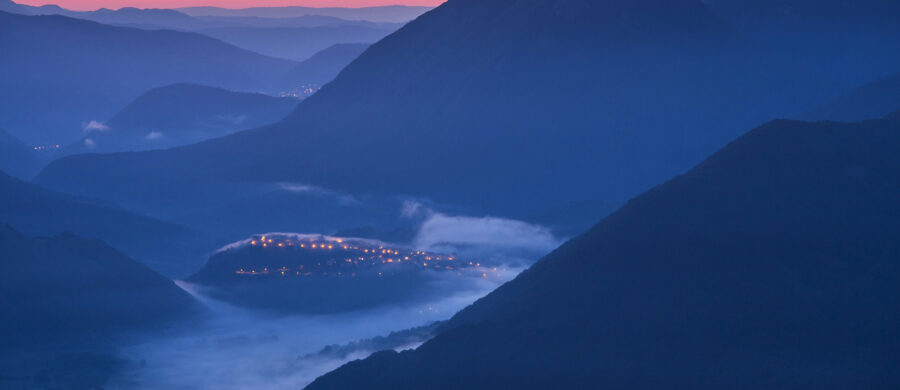
Italy’s wild heart is made up of more than 1300 square kilometres of steep mountains and deep valleys, furrowed by numerous watercourses and covered by imposing forests, home to an astonishing nature which has almost miraculously survived just a stone’s throw from great cities such as Rome and Naples. Despite its proximity to the sea, the climate here is more inclement than in typically Mediterranean zones. The summers are dry and the winters are cold and snowy. The peaks can be covered by a white blanket from mid-December until the end of March and sometimes beyond. The predominant environments are deciduous forests, followed by mountain grasslands, pastures and scrub. Along the bottom of the valleys, there are numerous villages, together with surviving areas of cultivated and uncultivated land. Below an altitude of 1300 metres, the woods are dominated by turkey and downy oaks (Quercus cerris and Q. pubescens), while at higher altitudes the beech (Fagus sylvatica) reigns supreme. The Park is also home to some of Europe’s oldest beech forests, where the trees grow, reproduce and die a  “natural death “, following natural cycles that favour the establishment and life of a great number of animal and plant species. But the woods are also rich in sycamores and maples (Acer spp.), wild fruit trees (such as Pyrus pyraster, Malus sylvestris, Prunus spp. and Sorbus spp.), together with domestic varieties of apple, pear, plum and cherry scattered throughout the cultivated and uncultivated land.

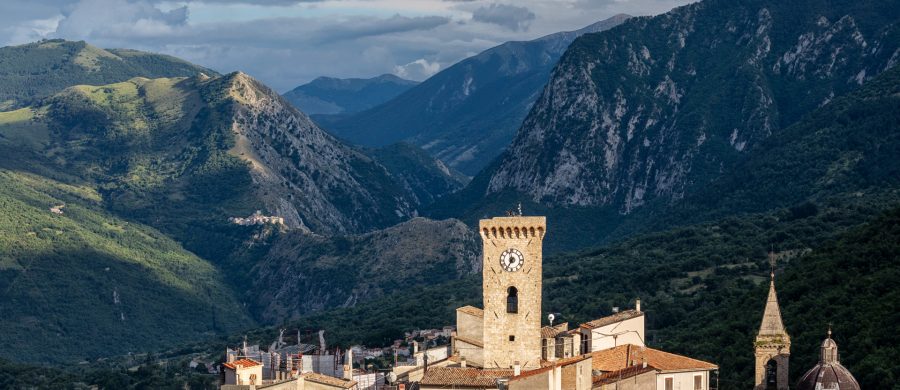
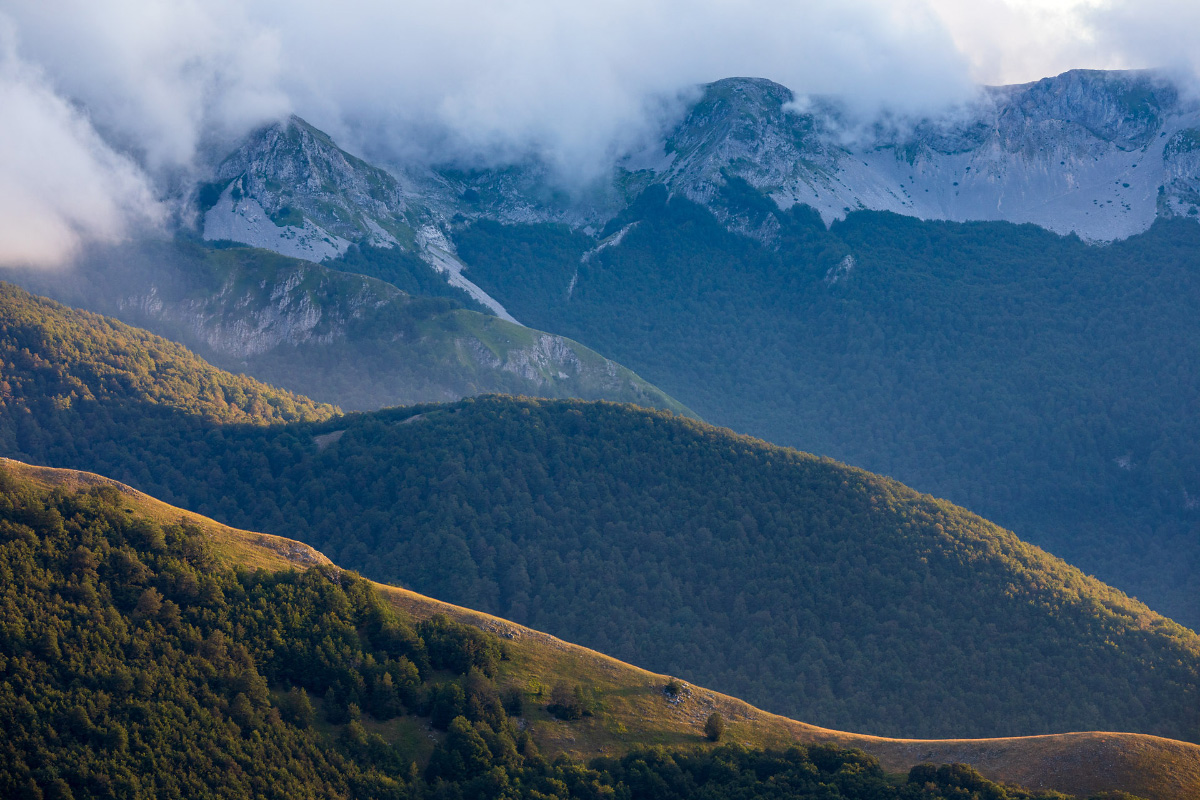
After a spring thunderstorm, the clouds part, revealing a glimpse of the forests and snow-capped peaks of a valley in the Abruzzo, Lazio and Molise National Park.

The product of millennia of human history with its ups and downs, this mosaic of environments has a very varied scrub community, including numerous fruit-bearing plants such as bramble, raspberry, viburnum and cornel, to name but a few. The mountain and sub-mountain belts are dotted with verdant mesophilous semi-natural grasslands (Festuco-Brometea), while above an altitude of 1800 metres, the extensive primary grasslands host a rich variety of herbaceous plant communities (Seslerion apenninae, Festuco-Trifolietum thalii). The deep, nitrate-rich soils near the sheepfolds and the preferential routes followed by flocks or watercourses are colonised by various herbaceous plants such as chervil, good king Henry and nettle (Chaerophyllum spp., Chenopodium spp., Rumex spp. and Urtica spp.).

Some of the best known and most valuable species in the biodiversity of the ALMNP: White-backed woodpecker (Picoides leucotos lilfordi); Apennine chamois (Rupicapra pyrenaica ornata); wolf (Canis lupus); Alpine longhorn beetle (Rosalia alpina); lady’s slipper (Cypripedium calceolus); beech (Fagus sylvatica); Ursini’s viper (Vipera ursinii), Marsican iris (Iris marsica); Rock partridge (Alectoris graeca); Italian fire salamander (Salamandra salamandra gigliolii).

The valleys, forests and rocky environments are populated by a great variety of vertebrates and invertebrates, including many species endemic or very rare elsewhere. The Park protects most of the species typical of mountain ecosystems and the Apennines in particular. Among the mammals, the community of wild ungulates is especially significant, with red deer (Cervus elaphus), roe deer (Capreolus capreolus), wild boar (Sus scrofa) and the exclusive Apennine chamois (Rupicapra pyrenaica ornata), potential prey not only for the bear, but also the wolf, present here with a high density population (5 wolves/100 km2). But the herbivores are not all wild. From early summer until early autumn, domestic animals (sheep, goats, cows and horses) are still grazed in these mountains, often at high densities and, in the case of cattle and horses, in a semi-wild state. Throughout the area, there are guard dogs associated with the livestock, as well as stray and feral dogs.

The stronghold of bears

Enter the heart of the Apennines, along the valleys shaped by people up to the highest peaks, from which the view ranges over vast forests and towards new territories.

Since the Neolithic, the landscape of the Apennines has developed hand in hand with man’s activities, in particular sheep farming, the real force shaping the territory. The traces of all this can still be seen in the abandoned cultivations and remains of old sheepfolds present in even the most remote areas, as well as in the network of paths and roads still existing almost everywhere. Today, the average population density (±SD) in the Park is  about 15 persons/km2, while the density of paved roads in the Park amounts to 39 km/100 km2. Animal husbandry, tree felling and tourism are important economic resources, while arable farming is now mainly confined to areas of the valley floor near the villages. Utilisation of the woods is carried out with the authorisation of the Park, with the exception of certain particularly delicate areas rented by the Park Authority itself to prevent deterioration of the habitat. Hunting (wild boar, hares and birds) is allowed exclusively in the buffer area around the Park between the months of October and January.

Many traditional ways of using the land are practised in the ALMNP, including tree felling, with the logs still carried out by mules and horses.

For the historical, cultural and ecological complexity of this area, the relationships linking bears, the Apennines and man can be truly countless and surprising. More than in many other regions of the planet, the life of bears in these mountains has been inextricably entwined with their surroundings for thousands of years, from a blade of grass or an ant to man and his activities. The relationship with our species in particular has always been polarised between two extreme opposites of attraction and repulsion, varying constantly down the centuries according to the culture prevailing at the time.

BACK
error: Content is protected !!